What is a data operations center?
Learn More
What is a data operations center?
Learn More

.png)
Our team was onsite at Snowflake Summit 2026 and here's what stuck and where we think the story isn't finished yet.
Snowflake Summit 26 Recap: The Agentic Enterprise and the Cross-Platform Gap It Leaves Open

2026 Snowflake Summit wrapped at Moscone with one message repeated from every stage. The agentic enterprise is here and your own governed data is the thing that makes it work. Across 20,000-plus attendees and 500-plus sessions, the announcements laddered up to a single claim Sridhar Ramaswamy opened with: everyone has the same frontier models, so the only advantage left that competitors can't buy is your proprietary data and the context wrapped around it.
Our team was onsite and here's what stuck, and where we think the story isn't finished yet.
The lines between data roles are collapsing
The clearest shift on the floor wasn't a product, it was a vocabulary change (amongst a lot of new buzzwords). Analytics people were asking us about upstream engineering. Data engineers were asking how their pipelines actually serve the business and the analysts downstream. The old boundaries between data engineering, analytics, and operations are thinning out and the reason is structural: context layers, MCP, and agentic applications are spreading fast enough that everyone now touches the same surface.
Snowflake leaned into this directly. Horizon Context and Cortex Sense push a governed context layer under the agents and the intent to acquire Natoma brings MCP-based connectivity in natively, so an agent can reach an application through one standard channel instead of brittle custom wiring. CoWork, the rebrand of Snowflake Intelligence, puts a knowledge-worker agent on top of that data, and CoCo (formerly Cortex Code) does the same for builders. Once an agent can read context and act across the stack, it stops mattering whose job the boundary used to be.
Your data context is the moat, and it has to be portable
"Your data is your competitive moat" was the line Ramaswamy kept returning to, and the room agreed. The model isn't the edge anymore. The edge is proprietary data context: securing it, structuring it, and getting it to the right hands at the right moment.
The part Snowflake said less about is where that context has to live. Our take from the week: context needs to be headless and delivered to where work happens. If using your context requires someone to stop and visit a portal, you've already lost the workflow battle. The most convincing demos on the floor met people inside the tools they already use: an agent updating a Jira ticket, surfacing an answer in chat, or running in the background while the engineer did something else.
This showed up in how people talked about reporting too. Far more conversation centered on AI applications served by trustworthy data than on the dashboard as the final destination. The dashboard isn't going away, but the center of gravity is moving toward applications and agents that consume governed data directly, which only works if the data underneath is reliable and the lineage is clear.
Agents everywhere, humans still in the loop
For all the energy around autonomy, the most grounded conversations we had landed in the same place. Every time we brought up that our own resolution playbooks keep a human in the loop, the response was agreement: that's the right approach right now. The practitioners we talked to understand that the security and control questions around letting agents take direct, autonomous action are not fully answered. The gap will close, probably faster than people expect, but this week the honest position was caution.
Snowflake clearly knows this too. AI Agent Identity shipped to GA with cryptographic identity for every agent before it touches data, per-agent access control that isn't inherited from a user's credentials, and full audit trails of agent activity. As Christian Kleinerman put it, the old security models were built for human users, not autonomous software. That's the real precondition for autonomy, and it's why the co-pilot pattern still wins: the agent does the investigation and proposes the fix, a person approves, and the work keeps moving.
The other recurring practitioner theme was cost and consolidation. With token costs climbing, teams are trying to optimize the tooling they already run and cut the number of overlapping tools rather than add more. The products that drew real interest were the specific ones, obsessively focused on a concrete, high-value problem, rather than the ones selling "AI for everything." Specificity is what survives the buzzword cycle.
The cross-platform resolution gap
Here's the thread we kept pulling on. Snowflake showed agents that can catch and resolve data issues inside Snowflake, and that's a real step. But data issues rarely stay inside one platform. A failure correlates across the stack: an ingestion job lands a bad row, a transformation job downstream propagates it, and a reporting layer three steps later shows the wrong number, often while every individual system looks green. Resolving that means seeing and acting across every platform in the pipeline, not just the warehouse.
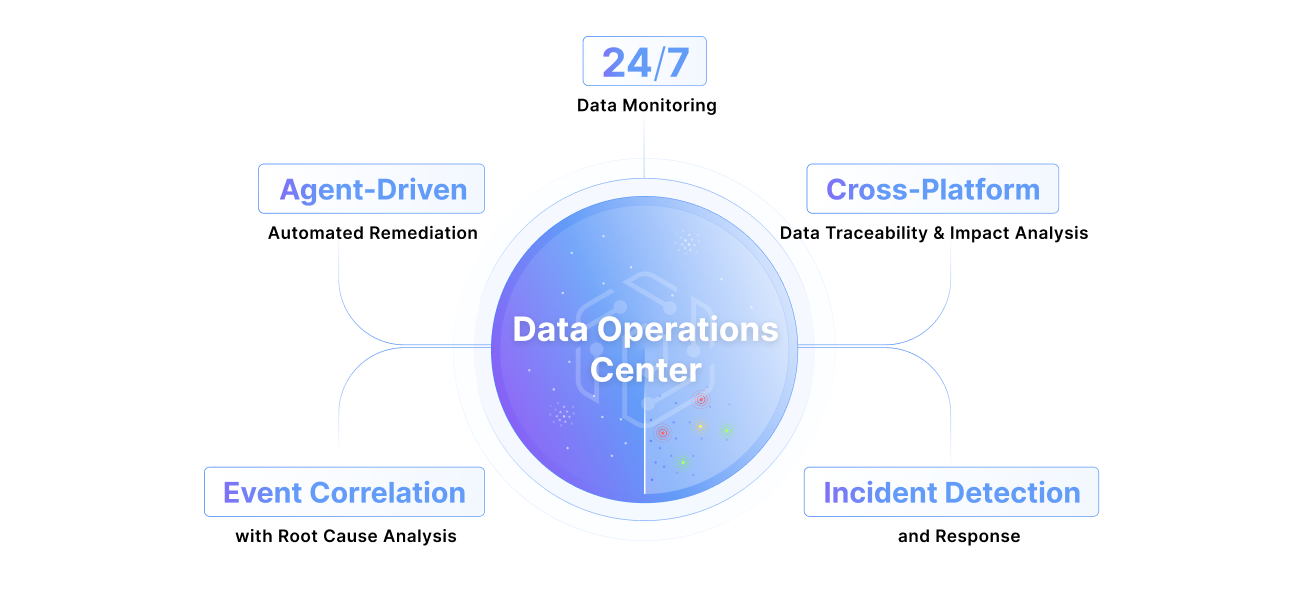
That's the market need Summit made obvious, and it's the problem Pantomath was built for. As the AI-powered Data Operations Center, Pantomath auto-discovers cross-platform traceability across the stack, including upstream tools like Airflow, Fivetran, and dbt, and publishes that lineage directly into Snowsight so a Snowflake team sees end-to-end dependencies without leaving the tools they already use. It integrates natively with Snowflake Data Quality, syncing DMFs that run on Snowflake compute, and routes every failing check into one incident framework with workflow rules to Teams, Slack, email, Jira, and ServiceNow.
Our purpose-built AI agents work the same co-pilot way the room kept endorsing. At the Recommend tier, live today with Fortune 500 data teams, the agents produce observations, root cause analysis, impact analysis, and a recommended resolution plan; a person approves and acts. Autonomous cross-platform resolution, where the agents take the action with human approval, is what we're co-developing with design partners now. The week confirmed that sequence is the right one.
Where this leaves us
Summit 26 made the direction unmistakable. The agentic enterprise runs on governed, proprietary data context, delivered where work happens, with humans approving the consequential actions until the controls catch up. Snowflake is building the governed foundation and the agents that sit on top of it. The cross-platform operations layer, the one that catches a data issue wherever it starts and traces it wherever it spreads, is the natural complement, and it's why Snowflake Ventures took an equity stake in Pantomath earlier this year.
If you run Snowflake as mission-critical infrastructure and you're working out how reliable data feeds your agents, that's the conversation we're having with teams now.
Keep Reading
.png)
July 14, 2026
From Lambda to Kubernetes: Re-Architecting the Pantomath Monitoring BusHow Pantomath moved its Monitoring Bus off Lambda onto Kubernetes and Karpenter for tenant isolation and queue-depth scaling, with zero disruption to customers.
Read More.png)
June 29, 2026
Pantomath's Purpose-Built AI Agents: Why We Replaced One Agent with a Team of SpecialistsPantomath rebuilt incident resolution around purpose-built AI agents: a fast triage step routes each data incident to a specialist grounded in your lineage.
Read More.png)
May 14, 2026
Rebuilding Lineage for Enterprise ScaleAt enterprise scale, data lineage stops being a UI feature and becomes a systems problem. We rebuilt Pantomath's Lineage Explorer from the ground up, new renderer, new data layer, new layout engine, to handle thousands of nodes without breaking a sweat.
Read More