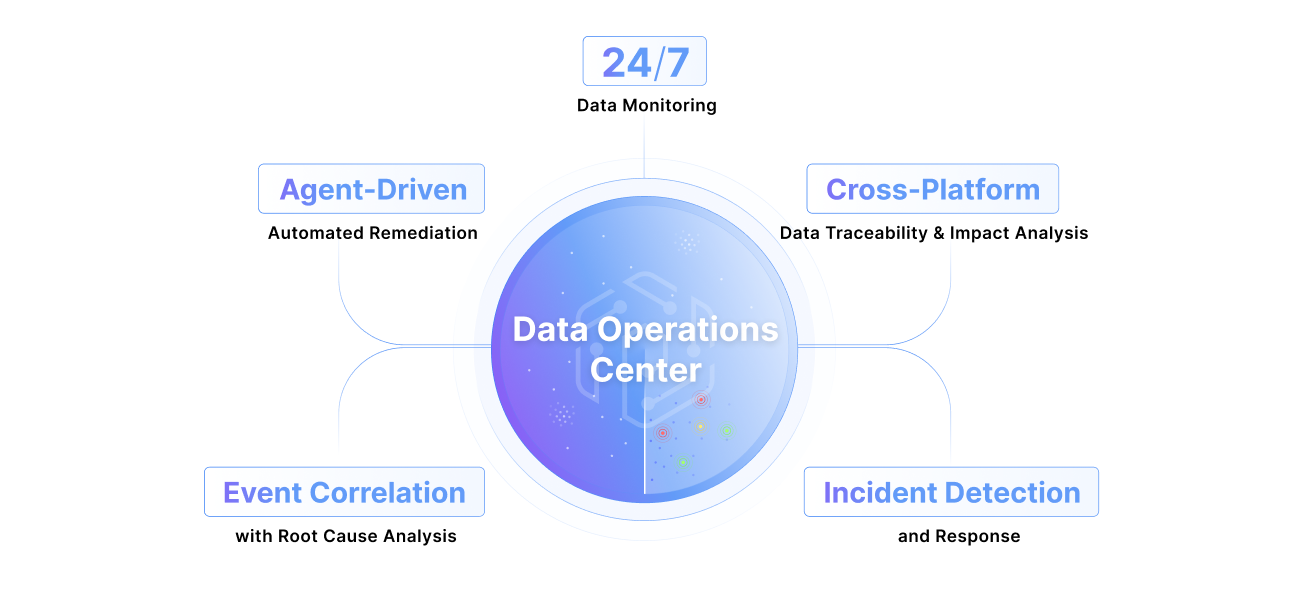
What is a data operations center?
Learn More
What is a data operations center?
Learn More

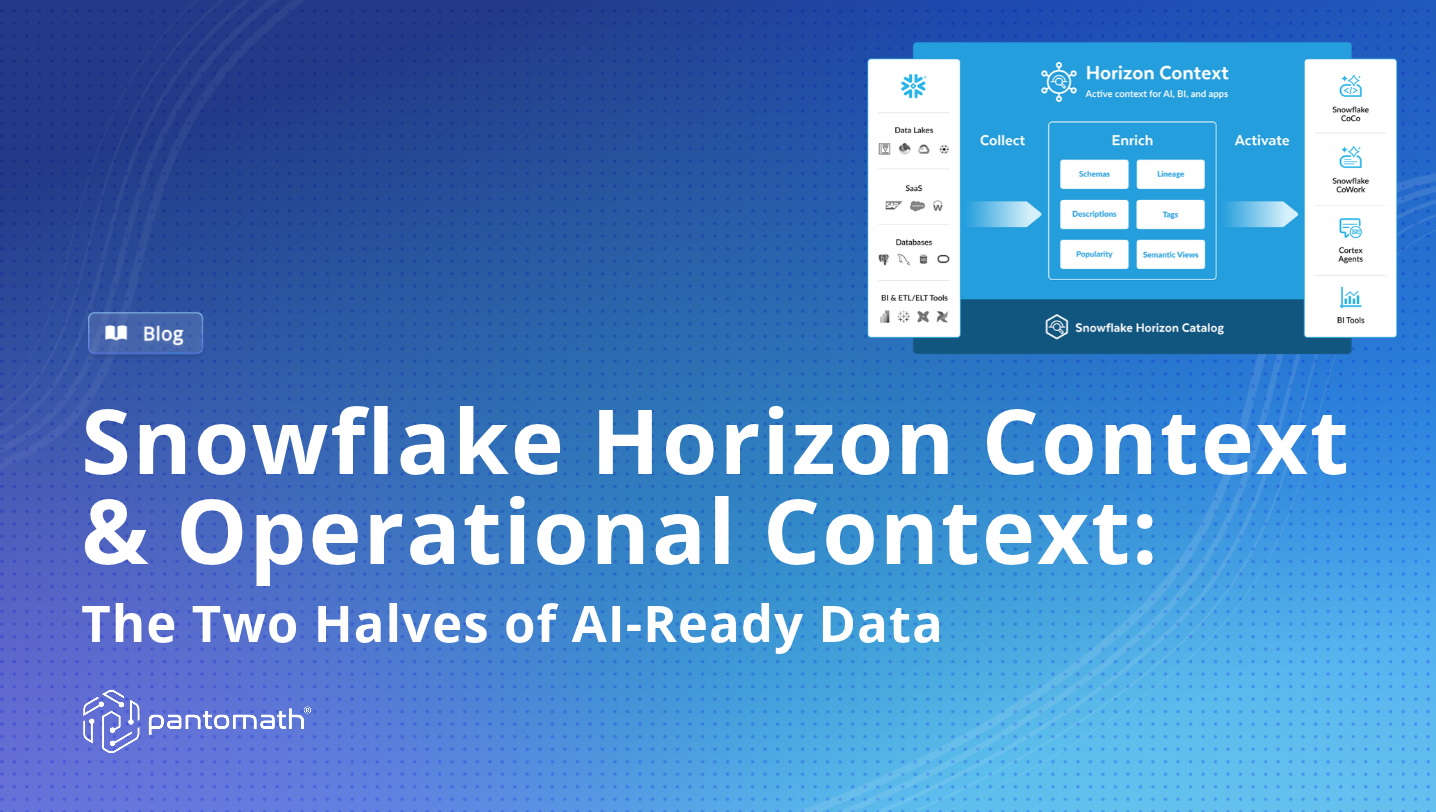
Horizon Context brings external metadata and cross-platform lineage into Horizon Catalog. Here's the operational context AI agents also need.
Snowflake Horizon Context and Operational Context: The Two Halves of AI-Ready Data

A finance analyst asks a Cortex Agent for last quarter's net revenue in the Northeast. On meaning, the agent gets everything right. It finds the governed metric in a semantic view, reads from the certified mart, and can trace column-level lineage all the way to the Power BI dashboard finance already trusts. The answer still comes back about 8% low, because the overnight SAP billing load copied half a batch and the dbt run on top of it built anyway.
The agent had the right context about what the data means, but in this case, the data wasn’t complete.
AI-ready data needs two kinds of context. Semantic context answers what this data is, what it means, and who may see it. Operational context answers whether the pipeline producing it is running, on time and healthy, and if not, what broke and who is affected. With Snowflake and Pantomath together, your agents can get both.
What Horizon Context added in October
Snowflake introduced Horizon Context in preview on October 12, extending Horizon Catalog beyond Snowflake (Snowflake release notes). It adds metadata connectors to 18 sources, including Power BI, Tableau, dbt, Databricks, BigQuery, SQL Server and Oracle, so teams can browse external assets, trace column-level lineage across platforms, and manage tags and descriptions in one catalog, down to the contacts on a Tableau dashboard. External lineage had already reached general availability on September 3 (Snowflake feature updates), and Snowflake has framed the first day of Expedition around giving enterprise AI the business context it's missing (Snowflake announcement).
For anyone who has tried to answer “what feeds this dashboard?” across four tools, this is a real step. Definitions, tags, access policy and lineage now sit in one governed place where agents can use them.
What a metadata connector collects
Horizon's connectors collect metadata, lineage and popularity data from BI tools, databases and pipeline tools (Horizon Catalog connectors). That describes the shape of the estate: which assets exist, how they connect, and how heavily they're used.
Operational questions sit on another axis. Did the 4:00 a.m. Fivetran sync finish, and with how many rows? How long does the Airflow DAG usually take, and is it running long today? Did the dbt run fail, and which dashboards are now showing stale numbers? Who owns the fix? Answering those takes run state for every job on the path (schedules, durations, completion times, failures) tied to the tables, reports and business owners downstream.
Lineage tells you what's connected. Operational context tells you what's happening along those connections right now.
“Horizon has cross-platform lineage now. Do we still need Pantomath's?”
They draw different maps. Horizon's lineage connects data objects (tables, columns, dashboards), now including assets outside Snowflake. Pantomath's lineage runs through the jobs that move the data, from the Fivetran sync and the Airflow DAG to the dbt run and the BI refresh, and keeps each job's run health on the graph. When a dbt run fails at 5:40 and the dashboard refreshes at 6:00, the object graph shows that the two are connected. The job graph shows that the connection is broken, which upstream job broke it, and who to call.
The two maps also meet inside Snowflake. Pantomath publishes its cross-platform lineage into Snowsight and keeps it refreshed as pipelines change, so platform teams see upstream jobs and downstream dependencies without switching tools.
How the two halves fit in one Snowflake account
Take the revenue question again, with both kinds of context in place:
- Horizon holds the definitions, tags, access policies and catalog, and semantic views keep the agent's metric correct.
- Snowflake Data Quality holds the checks as DMFs. Pantomath syncs them in both directions, monitors across seven dimensions plus fully custom checks, and runs them on your Snowflake compute.
- Pantomath holds the run state: every ingestion, orchestration and transformation job, its normal behavior, and the incident that opens when it fails, runs late or never starts. That incident carries the upstream cause and the downstream reports and owners, and routes to Teams, Slack, email, Jira or ServiceNow.
So when the SAP billing load copies half a batch at 2:10 a.m., Pantomath opens an incident, marks the finance mart and the revenue dashboard as impacted, and tells the owner. Pantomath also delivers that operational context to teams and their AI assistants in the tools they already use, so anyone checking the mart in the morning sees that it's incomplete and why, before a confident wrong number goes into a forecast.
AI-ready data has to be understood and on time
Snowflake is making semantic context native, and agents get better at understanding data because of it. Agents can also know whether the data they're about to use arrived complete and on time, and that answer comes from the pipelines. Pantomath works toward zero data incidents there: issues still happen, but none escalate into a business-impacting incident. Meaning without timing gives you a well-described wrong answer.
FAQ
What is Snowflake Horizon Context? A preview Snowflake announced on October 12, 2026 that extends Horizon Catalog beyond Snowflake. It adds metadata connectors to 18 external sources, cross-platform column-level lineage, and management of external metadata such as tags and descriptions on BI dashboards.
Is Pantomath a data catalog? No. Pantomath is a Data Operations Center: it catches, resolves and prevents data issues across the stack before they become business-impacting incidents. It works alongside Horizon Catalog, publishing lineage into Snowsight and syncing with Snowflake Data Quality.
How do Snowflake customers get Pantomath? Pantomath is listed on the Snowflake Marketplace, and Snowflake Ventures holds an equity stake in the company.
Related reading: Snowflake Summit 26 recap: the agentic enterprise and the cross-platform gap it leaves open and how Pantomath works with Snowflake.
Keep Reading
August 26, 2026
Rearchitecting Pantomath's Extractor FleetHow Pantomath consolidated 25+ metadata extractors into a pnpm monorepo and one unified runtime, so a fleet-wide change ships as one PR instead of 25.
Read More
July 14, 2026
From Lambda to Kubernetes: Re-Architecting the Monitoring BusExplore From Lambda to Kubernetes Re Architecting the Pantomath Monitoring. Get practical Pantomath insights on data operations, observability.
Read More
June 29, 2026
Pantomath's Purpose-Built AI AgentsPantomath rebuilt incident resolution around purpose-built AI agents: a fast triage step routes each data incident to a specialist grounded in your lineage.
Read More